Address
304 North Cardinal
St. Dorchester Center, MA 02124
Work Hours
Monday to Friday: 7AM - 7PM
Weekend: 10AM - 5PM
Address
304 North Cardinal
St. Dorchester Center, MA 02124
Work Hours
Monday to Friday: 7AM - 7PM
Weekend: 10AM - 5PM
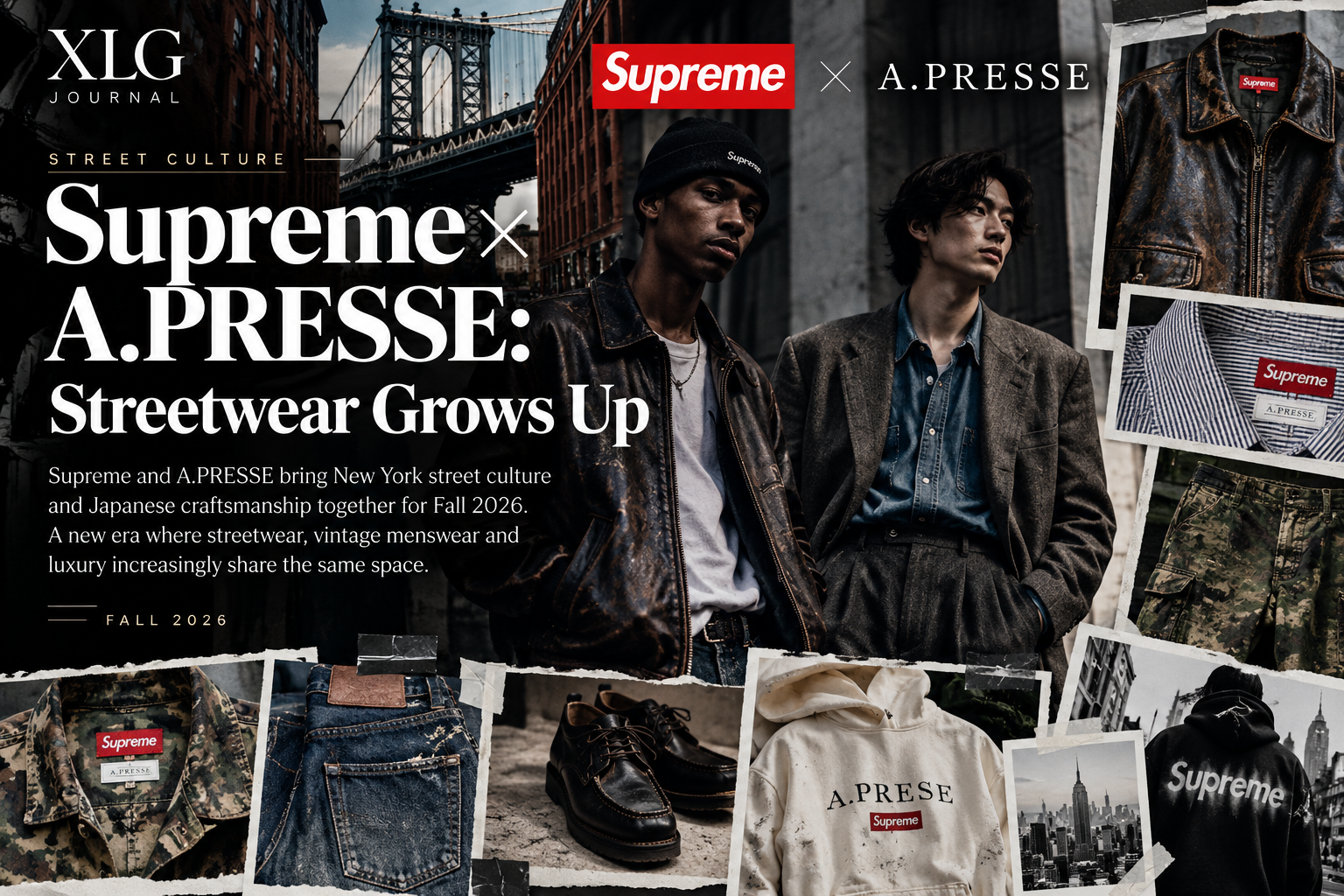
Category:STREET CULTURE
Supreme joins forces with Tokyo label A.PRESSE for one of Fall 2026’s most unexpected collaborations—a meeting of New York street culture, Japanese craftsmanship and vintage-inspired menswear.
Streetwear collaborations are nothing new.
For decades, collaborations have been one of the engines driving sneaker and street culture. Logos collide, limited quantities create demand, and unexpected partnerships generate conversation.
But every once in a while, a collaboration feels different.
In September 2026, Supreme revealed its Fall 2026 partnership with Japanese label A.PRESSE.
On paper, the two brands come from very different worlds.
Supreme was born from New York skate culture.
A.PRESSE approaches clothing through vintage references, carefully selected materials and obsessive construction.
Put them together, however, and the result says something interesting about where streetwear is heading.
A.PRESSE was founded by designer Kazuma Shigematsu in 2021.
The Tokyo label has developed a following by taking familiar pieces—jeans, sweatshirts, military trousers and traditional menswear—and rebuilding them with close attention to fabric, construction, finishing and aging techniques. GQ
That philosophy makes the Supreme collaboration unusual.
Instead of relying primarily on loud graphics, the Fall 2026 collection places greater emphasis on materials and construction.
The collection includes calfskin outerwear, silk-cotton tailoring, Oxford shirting and pieces featuring hand-applied camouflage treatments. Hypebeast
It still belongs to the Supreme universe.
But the language feels more mature.
Supreme helped establish a formula that became fundamental to modern streetwear:
A recognizable graphic.
A limited drop.
A community that understands its cultural meaning.
That formula remains powerful.
But streetwear has expanded far beyond it.
The A.PRESSE collaboration demonstrates how easily tailoring, leather outerwear and vintage-inspired garments can now exist alongside traditional skate clothing.
A suit no longer automatically represents formalwear.
A distressed leather jacket doesn’t need to belong to one particular subculture.
And a streetwear brand doesn’t have to produce only hoodies and graphic T-shirts.
The boundaries have become increasingly irrelevant.
One of the most interesting shifts in contemporary street culture is the growing fascination with clothing that appears to have already lived a life.
Perfect can sometimes feel boring.
Faded denim.
Washed cotton.
Distressed leather.
Vintage military garments.
Old workwear.
These objects contain texture and character that perfectly manufactured clothing sometimes lacks.
A.PRESSE has built much of its identity around recreating that feeling through modern construction. GQ
It reflects a broader change in how younger consumers think about luxury.
Luxury doesn’t always need to look new.
Sometimes craftsmanship is most interesting when it creates something that feels old.
Japanese fashion has played an enormous role in streetwear’s evolution.
Tokyo has long developed its own interpretation of American denim, military clothing, workwear, skate culture and Ivy style.
Rather than simply reproducing those influences, Japanese designers often study them in extraordinary detail before rebuilding them through different fabrics, proportions and manufacturing techniques.
A.PRESSE belongs to that tradition.
Its collaboration with Supreme therefore creates an interesting cultural loop:
American clothing influences Japan.
Japan reinterprets it.
Then that interpretation returns to New York streetwear.
The result is something familiar—but different.
The Supreme × A.PRESSE release also arrives during a period when streetwear is becoming less dependent on obvious branding.
That doesn’t mean logos are disappearing.
Supreme itself proves they still carry enormous cultural power.
But alongside graphic-heavy streetwear, there is growing interest in clothing whose value is communicated through silhouette, fabric, construction and subtle details.
The person who understands the garment recognizes it.
Everyone else simply sees a good jacket.
That kind of understated recognition has traditionally belonged to luxury fashion.
Increasingly, it belongs to streetwear too.
None of this means classic streetwear has disappeared.
Quite the opposite.
As Fall 2026 begins, hoodie culture remains highly visible. Vogue Business’s September TikTok tracking found users showing hoodie rotations, collections and unboxings, with Supreme, Stüssy and Denim Tears among the streetwear names appearing in the trend. Vogue
The difference is that the hoodie now exists inside a much larger wardrobe.
It can sit beside tailoring.
Vintage denim.
Luxury watches.
Technical footwear.
Leather jackets.
And designer accessories.
Streetwear isn’t being replaced.
It’s absorbing everything around it.
Footwear is experiencing a similar shift.
There is no longer one universally dominant sneaker formula.
GQ’s September coverage shows everything from heritage models and collaborations to rugged approach shoes and unusual material treatments competing for attention. Even houndstooth—a pattern traditionally associated with tailoring—has appeared across new sneaker releases. GQ
That diversity makes contemporary sneaker culture harder to define.
And arguably more interesting.
The coolest shoe doesn’t necessarily have to be the rarest shoe anymore.
Perhaps that is the real significance of Supreme × A.PRESSE.
It would be difficult to define the collection using the old boundaries between:
Streetwear.
Menswear.
Luxury.
Vintage.
Skate.
It contains pieces of all of them.
And that increasingly describes modern fashion itself.
People don’t necessarily dress according to one category anymore.
A Supreme jacket can sit beside vintage Levi’s.
Japanese tailoring can be worn with sneakers.
A luxury watch can appear underneath the sleeve of a hoodie.
The contrast becomes the style.
Streetwear doesn’t need another definition.
Its ability to constantly absorb new influences is exactly what has kept the culture alive.
Supreme × A.PRESSE represents a version of streetwear that feels less concerned with proving that it belongs to street culture.
The craftsmanship can speak.
The materials can speak.
The styling can speak.
The logo becomes only one part of the story.
Streetwear isn’t disappearing.
It’s growing up without forgetting where it came from.
— XLG Journal