Address
304 North Cardinal
St. Dorchester Center, MA 02124
Work Hours
Monday to Friday: 7AM - 7PM
Weekend: 10AM - 5PM
Address
304 North Cardinal
St. Dorchester Center, MA 02124
Work Hours
Monday to Friday: 7AM - 7PM
Weekend: 10AM - 5PM
第四篇我建議接原本規劃的 LUXURY NEWS,主題就用剛在 2026 年 9 月 22 日舉行的 Vogue World: Milano 2026。這篇和前三篇差異會很大,重點不是單一品牌,而是「義大利工藝 × 科技 × AI 時代的奢華」。Vogue World 今年確實在米蘭 Galleria Vittorio Emanuele II 舉行,而且活動才剛結束幾天,很適合 XLG 做成即時時尚新聞。Vogue
Category: LUXURY NEWS
Inside Vogue World: Milano 2026, where Italian craftsmanship, fashion history and emerging technology came together beneath the glass ceilings of the Galleria Vittorio Emanuele II.
On September 22, 2026, one of Milan’s most recognizable landmarks became something entirely different.
The historic Galleria Vittorio Emanuele II, positioned between the Duomo and Teatro alla Scala, was transformed into the stage for Vogue World: Milano 2026.
The event coincided with the opening day of Milan Fashion Week and marked the fifth edition of Vogue World, following previous editions in New York, London, Paris and Hollywood. Vogue
But Milan was not selected simply because of its position in global fashion.
The central idea was craftsmanship.
At a moment when artificial intelligence and digital technologies are rapidly reshaping creative industries, Vogue World turned its attention toward the relationship between the human hand and the machine.
Italian luxury has always been closely connected to making.
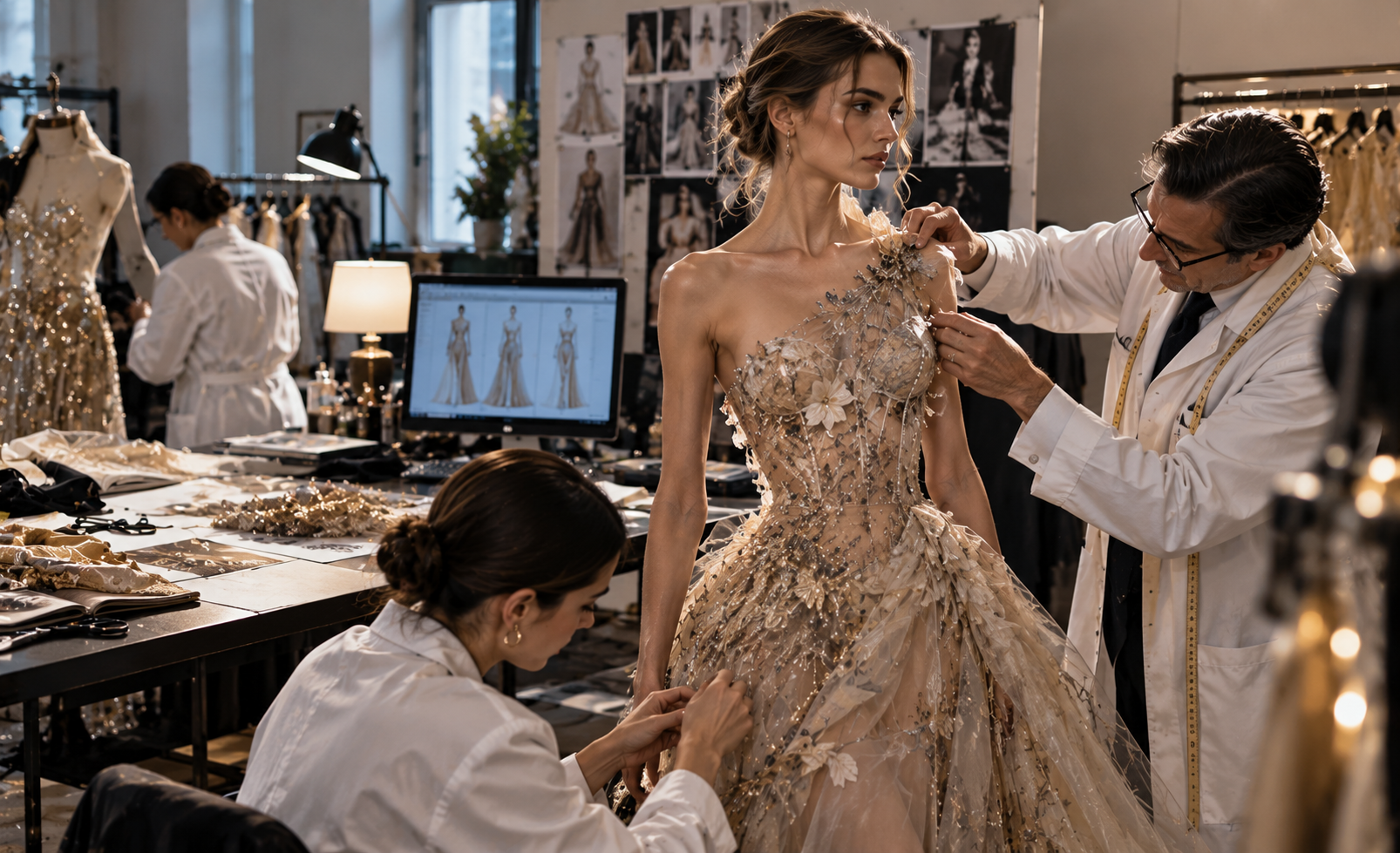
Leather working, tailoring, jewelry, embroidery and textile production remain fundamental to the idea of Made in Italy.
Vogue World Milano built its narrative around that history.
The event opened with artisans and objects representing Italian craft—including a model of Milan’s Duomo, a celestial globe and a loom—before moving through different periods of design and manufacturing.
According to Vogue, the event included 18 artisans representing 15 Italian fashion houses in its opening sequence. Vogue
It was an unusual way to begin a major fashion spectacle.
Instead of placing celebrity or branding at the center immediately, the people and processes behind luxury were given the first word.
The production was divided into five acts.
The Artisanal Revolution looked toward Renaissance-era craftsmanship, celebrating brocade, lace, embellishment and hand-worked textiles.
The Industrial Revolution moved into Italy’s manufacturing history, drawing inspiration from Turin and the development of industrial production.
Made in Italy celebrated color, print, Italian cinema and the glamorous mythology of La Dolce Vita.
Then came The Age of Intelligence, where craftsmanship met advanced technology.
Finally, The Imagination Revolution looked beyond the present toward a more speculative vision of fashion’s future. Vogue
Together, the five chapters presented fashion not simply as clothing, but as the result of centuries of interaction between creativity, culture and technology.
One of the night’s most striking moments came during The Age of Intelligence.
Four humanoid robots appeared on the runway alongside models.
Their inclusion was deliberately unexpected.
Vogue described the sequence as part of the event’s wider examination of human creativity in an age increasingly shaped by artificial intelligence. The robots were produced by Unitree Robotics and appeared alongside models including Alex Consani, Ruth Deng and Yumi Nu. Vogue
It created a visual question at the center of the entire event:
What happens to craftsmanship when machines become increasingly capable of creating?
Vogue World’s answer was not to frame technology as the enemy of craftsmanship.
Instead, the show presented technology as another chapter in a much longer story.
Vogue World also demonstrated how the traditional definition of a fashion show continues to expand.
Models shared the environment with artisans, performers and international personalities, while music and theatrical elements transformed the Galleria into something closer to a cultural production than a conventional runway.
Even Teatro alla Scala became part of the evening.
Members of its chorus participated throughout the five-act production, including performances connected with La Traviata. Vogue
Fashion, architecture, music, history and technology were deliberately placed in the same space.
That combination reflects an important shift in contemporary luxury.
Consumers are no longer encountering brands only through products.
Increasingly, luxury is communicated through experiences.
That experience-driven approach is becoming particularly important during a difficult period for the global luxury sector.
Reuters reported this week that many major luxury companies are facing softer consumer demand and greater economic uncertainty. Brands are therefore investing heavily in runway productions, stores, services and exclusive experiences as they compete for high-end customers. Reuters
Vogue World Milano represents the spectacular end of that evolution.
The event was designed not merely to present clothes but to create imagery capable of moving far beyond the physical audience inside the Galleria.
A runway can last minutes.
Its cultural impact can travel much further.
Even the finale returned to the idea of creation.
More than 6,000 specially designed paper objects descended through the Galleria at the conclusion of the event. They were created by Jony Ive’s LoveFrom studio as part of a months-long project inspired by Milan and its relationship between designing and making. Vogue
It provided an appropriate conclusion.
After moving from Renaissance artisans to industrial manufacturing, Italian glamour, intelligent textiles and robotics, Vogue World ended with something remarkably physical:
objects falling through space.
Technology may change the tools.
But fashion still depends on ideas becoming tangible.
At XLG, we believe the future of luxury will not be defined by choosing between tradition and technology.
The more interesting future lies somewhere between them.
Vogue World: Milano 2026 demonstrated why Italian fashion remains such an important reference point. Its influence does not come only from famous logos or recognizable products. It comes from generations of knowledge about materials, proportion, construction and beauty.
Artificial intelligence may change how fashion is imagined, communicated and eventually produced.
But craftsmanship gives those ideas something technology alone cannot automatically provide:
history, character and human intention.
Perhaps that is why Milan was the right place for this conversation.
The future of luxury may become increasingly technological.
Its value, however, may depend more than ever on the human touch.
— XLG Journal